
Municipal & public safety
Support the people your community depends on.
A job-informed workforce-health model for fire, EMS, law enforcement, utilities, and municipal teams—built around shift work, physical demand, early access, and readiness.
The operating reality
The risks are connected—even when the systems are not.
Long shifts, physically demanding calls, heat exposure, disrupted recovery, and a culture of pushing through discomfort can make early action difficult.
A musculoskeletal issue can become restricted duty. Cardiovascular and metabolic risk can progress quietly between annual screenings. Generic resources may go unused when they feel disconnected from station life.
Support works differently when people know the person providing it, trust the next step, and can act before the problem owns the shift.
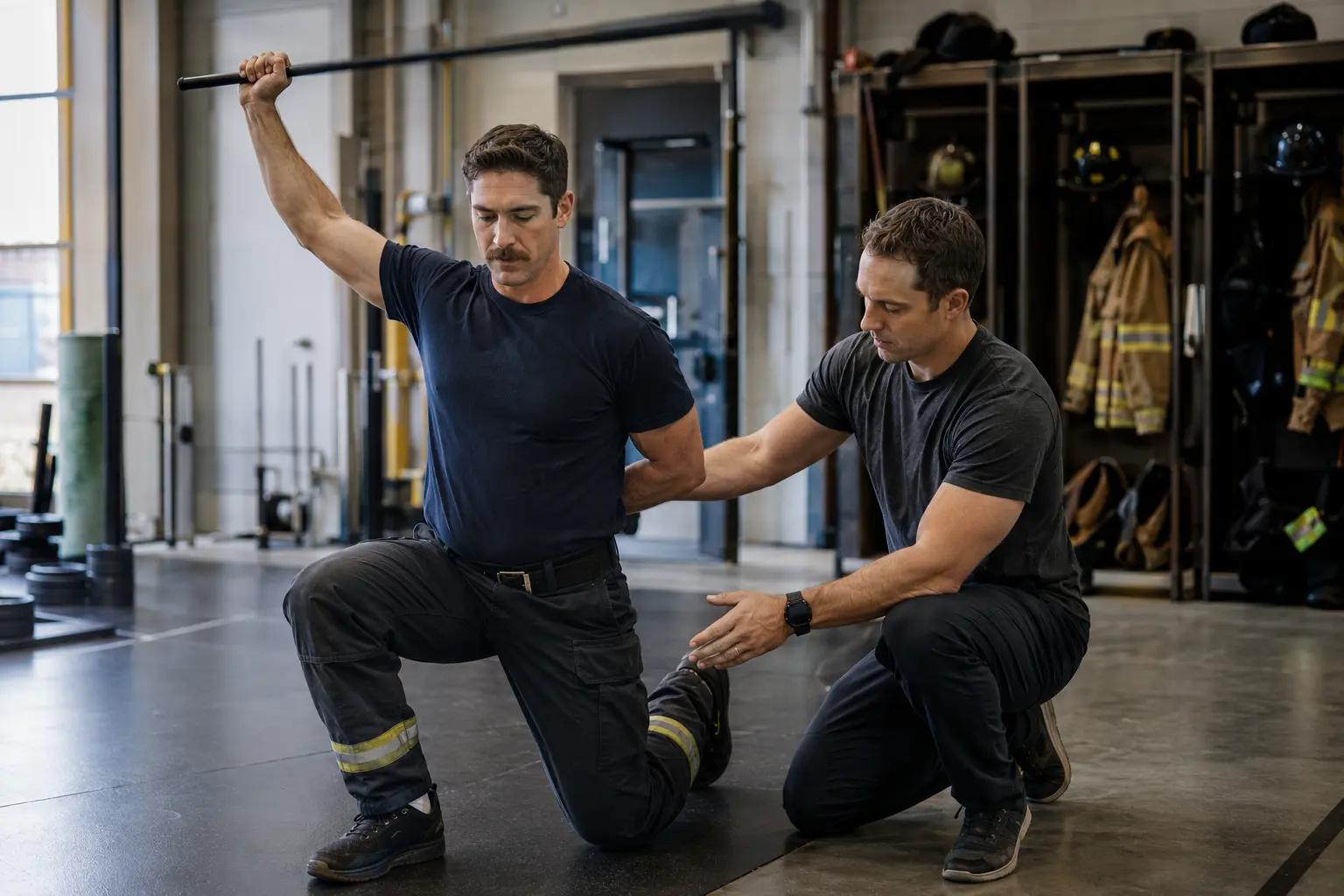
Built around the job
Support designed for the station, the shift, and the person.
The exact mix is tailored to the department’s current providers, schedule, peer-fitness structure, data, and goals.
01
Early musculoskeletal support
Accessible assessment and practical next steps before a manageable concern becomes prolonged restriction.
02
Physical readiness
Job-informed strength, conditioning, movement, mobility, and performance programming.
03
Cardiometabolic health
Practical education and follow-through around cardiovascular, metabolic, nutrition, and hydration priorities.
04
Sleep and recovery
Shift-aware support for fatigue, recovery, stress management, breathwork, and resilience.
05
Culture and engagement
Relationship-based support built around stations, shifts, peer structures, and operational reality.
06
Leadership and measurement
Program consultation, aggregate reporting, and coordination with established clinical and city pathways.
Bryan Fire Department
Reported light-duty duration differed between selected groups.
Eight H&W-involved light-duty instances averaged 12.2 calendar days during March 2023–March 2024. Seven No-H&W cases averaged 125.8 calendar days across the three-year program period.
The groups and time windows were not equivalent. Participation was voluntary; the groups were not randomized or severity-adjusted; injury mix, motivation, and referral access varied. Staffing or payroll savings were not audited, and the comparison does not establish causation.
12.2
average days with H&W involvement in program year one
compared with
125.8
average days without H&W involvement across three years
Works with your current system
This does not require abandoning the partners you trust.
The model is designed to work alongside the department physician, annual physical provider, city clinic, benefits team, workers’ compensation process, and peer-fitness structure. The first task is to understand where access and follow-through are breaking down.
Talk with us about your department